Furnished Housing for Medical Professionals: Travel Nurse & Locum Tenens Housing Made Simple
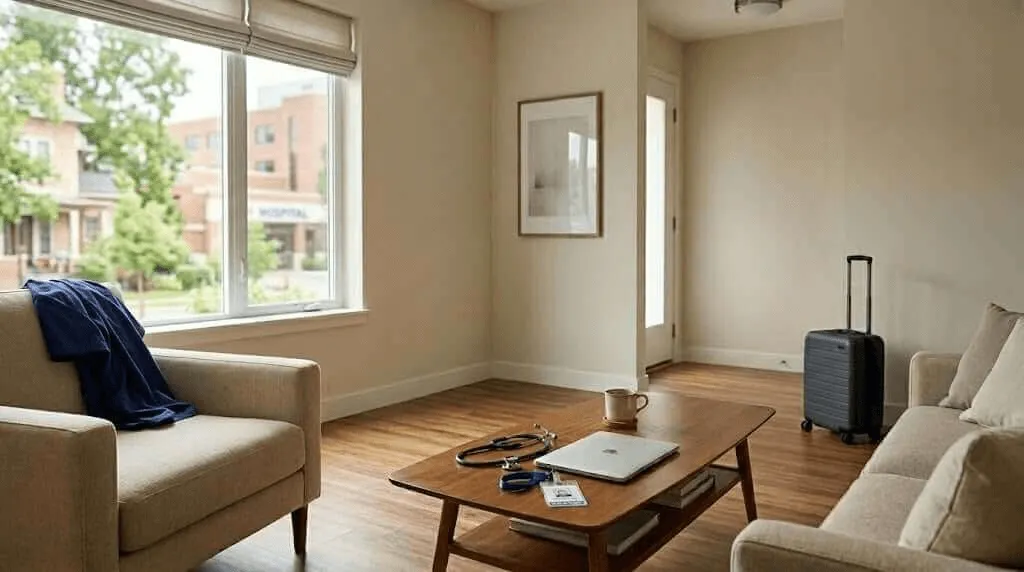
A practical guide for hospitals, staffing teams, and HR leaders placing travel nurses, locum tenens physicians, and project-based clinical staff - without adding friction to the assignment.

Table of Contents
Why Hospitals Are Re-Thinking Travel Nurse Housing
Hospitals don’t just staff shifts - they protect continuity of care. And when you bring in traveling clinicians, housing becomes an operational variable that quietly impacts three things leadership actually measures: reliability, performance and retention.
When housing is unstable, everything downstream gets harder: call-offs increase, onboarding stretches, fatigue rises, and teams spend time solving problems that were never clinical in the first place. Travel clinicians routinely evaluate housing through a simple lens: Can I recover here between shifts and show up ready again tomorrow?
Who This Guide Is For
Hospital decision-makers
HR leaders and talent acquisition
Operations leaders coordinating temporary coverage
Procurement teams managing vendor standards
Department leadership supporting surge staffing
Staffing and placement partners
Healthcare staffing agencies
Locum tenens coordinators
Workforce mobility teams
Corporate Housing vs Short-Term Rentals for Medical Assignments
1) Agency-placed housing
An agency sources and coordinates housing on behalf of the clinician. This reduces admin burden - but the clinician may have less choice, and the arrangement can affect how compensation is structured depending on the program.
2) Stipend-based (clinician finds their own housing)
This can work well for experienced travelers, but it shifts the quality-control problem onto the clinician - and creates variability in safety, commute time, and living conditions.
3) Professionally managed furnished housing (the “corporate housing” lane)
This is typically a furnished apartment/condo/home with utilities and internet in place, designed for 30+ day stays and professional assignments. It’s commonly used beyond traditional business travel - including traveling nurses and doctors.
What “Good” Looks Like in Furnished Housing Near Hospitals
Hospitals and agencies tend to over-focus on bed count and price and under-focus on the factors that actually determine whether the placement is stable.
Non-negotiables (for patient-care-adjacent performance)
Quiet + sleep reliability (especially for night shifts)
Commute discipline: predictable drive time to facility (late arrivals are often a housing problem in disguise)
Safety + professional management: clear support channel and documented standards
Utilities + Wi-Fi included: fewer “Day 1” failures
Parking + easy entry: friction matters after 12-hour shifts
“Nice-to-haves” that increase retention
In-unit laundry
A real kitchen (not just a microwave)
Workspace (small desk is enough)
Simple, clean furnishings - nothing flashy, nothing fragile
Furnished Housing vs. Hotels for Medical Assignments
Hotels have a place - especially for very short stays or while someone’s waiting for a unit to open. Many travel programs also use extended-stay hotels as a default option.
But for multi-week clinical assignments, furnished housing tends to win when you care about:
1) Recovery (not just “sleep”)
A living room and kitchen aren’t luxury - they’re what makes a high-intensity schedule sustainable.
2) Cost control over longer durations
Longer stays shift the math. Once you factor in repeated meals, laundry, and the “everyday life” costs of hotel living, furnished housing can stabilize total cost - especially for 30+ day assignments.
3) Fewer surprises
Professional management + move-in readiness is often the difference between a smooth start and a week of chaos.
A Hospital Checklist for Placement Speed, Safety, and Reliability
Step 1 — Classify the assignment
1–7 nights: hotel is often fine
2–4 weeks: depends on unit availability and clinician preference
30+ days: furnished housing becomes the stability play
Step 2 — Define “acceptable” commute radius
Set a clear drive-time target, not a mile radius. This prevents “close on paper, impossible in real life.”
Step 3 — Require a minimum standard checklist
Ask housing partners for a one-page “Unit Standards” sheet and make it non-negotiable.
Step 4 — Lock in support and escalation
If something breaks at 9:30 PM after a shift, what happens next? Demand a real answer.
What to Require from a Furnished Housing Provider (simple vendor checklist)
Quality + readiness
Cleanliness verification before move-in
Utilities confirmed active on Day 1
Wi-Fi speed expectations for remote charting/telehealth needs (if applicable)
Documentation + payment
Clear invoicing (weekly or monthly)
Single point of contact
Transparent cancellation / extension terms
Safety + suitability
Neighborhood screening approach
Professional management contact method
Maintenance response expectations
A Note on “Stipends” and Compliance (keep it simple)
Programs vary widely. If you’re structuring stipends or reimbursements, treat housing as a policy and compliance topic - not just a convenience perk. Keep the rules consistent, document them, and when needed, confirm specifics with your internal finance/tax professionals.
The Outcome That Matters Most
The goal isn’t just to “house a traveler.” It’s to create conditions where a medical professional can arrive stable, recover between shifts, and contribute at a high level - fast.
When housing is handled with the same seriousness as credentialing and onboarding, the placement becomes smoother for everyone: the clinician, the unit, and the patient experience.
Next Step
If your team places traveling clinicians and wants a repeatable, low-friction housing process, the best next move is standardizing your housing criteria and partner expectations - so every assignment starts clean and stays stable.
Frequently Asked Questions About Corporate Housing for Medical Professionals
What is corporate housing for medical professionals?
Corporate housing for medical professionals is furnished, move-in-ready housing used for temporary assignments - often 30+ days - so clinicians can live comfortably near the facility.
What is travel nurse housing?
Travel nurse housing typically refers to short- to mid-term furnished rentals that match contract timelines (often 8–13 weeks) and support working travelers with a “home-like” setup.
What is locum tenens housing?
Locum tenens housing is temporary lodging arranged for physicians and advanced practitioners on assignments; it may be a hotel, furnished apartment, or rental home depending on length and location.
Who pays for travel nurse or locum tenens housing?
Payment varies by employer and contract. Many staffing arrangements include company-provided housing or a stipend so clinicians can secure their own place.
Is corporate housing cheaper than hotels for medical assignments?
Often, yes - especially for stays beyond a few weeks - because furnished housing can reduce nightly rates and adds practical value (kitchen, living space, laundry).
How close should housing be to the hospital?
Best practice is to target a short, reliable commute (often 10–20 minutes where possible), prioritizing safety, predictability, and shift-friendly travel time.
What should hospitals look for in furnished housing near hospitals?
Focus on safety, cleanliness, reliable Wi-Fi, dedicated workspace, parking, responsive support, and flexible lease terms aligned with assignment changes.
What length of stay is “best” for corporate housing?
Corporate housing is ideal for mid-term stays—commonly 30+ days—especially for rotations, extensions, and project-based clinical coverage.
What are common mistakes with medical traveler housing?
Choosing based on price alone, ignoring commute reliability, unclear cancellation terms, weak support, and housing that isn’t truly “move-in ready.”
How do staffing teams place clinicians faster without sacrificing quality?
Use a repeatable checklist (distance/safety/amenities), keep an approved inventory, and work with partners who can flex dates and handle issues quickly.

CORPORATE HOUSING | RELOCATION STAYS | FURNISHED HOMES FOR PROFESSIONALS
30 N. Gould Street Suite R
Sheridan, WY 82801
OUR NEWSLETTER
Stay updated with the latest industry news and locations around the nation.
Designed by maxCEOS Digital